
What Is Status Quo Bias and How Does It Show Up in Scrum?
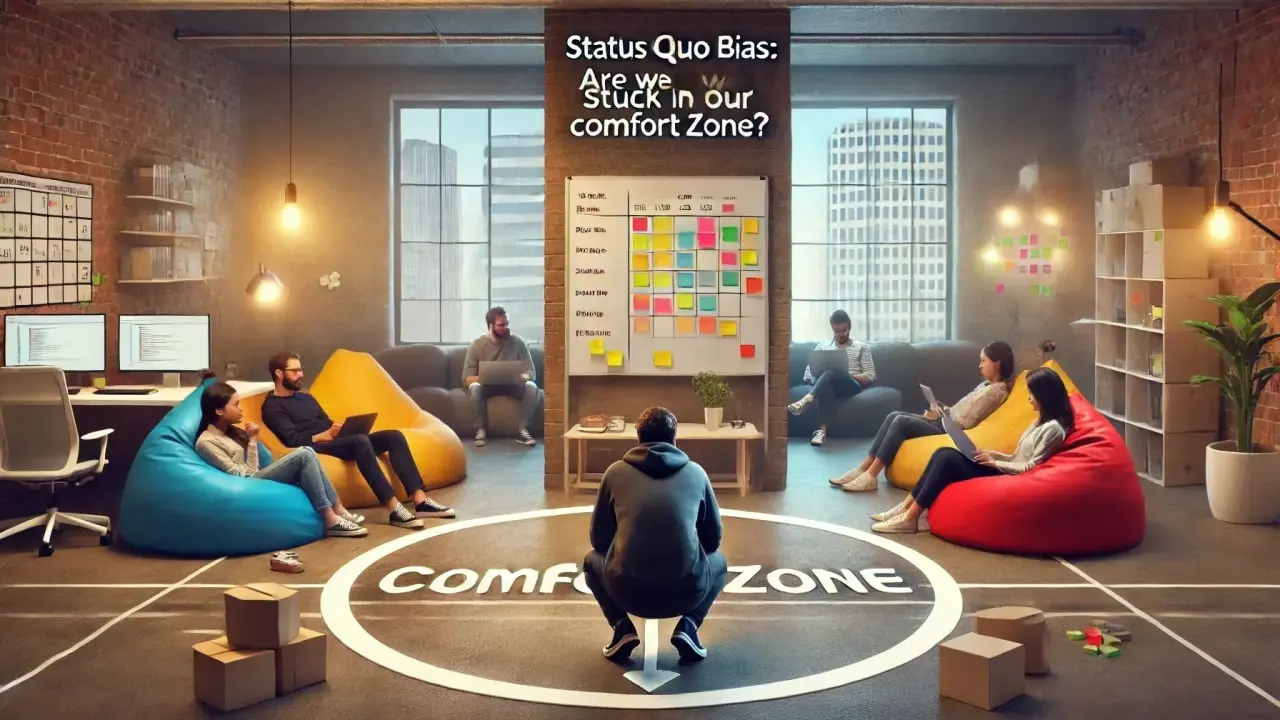
Status Quo Bias is the tendency to stick with the current way of doing things just because “that’s how we’ve always done it.” In Scrum teams, it can manifest as:
- Rejecting experiments simply because they’d disrupt established routines
- Being unwilling to change the structure of meetings—even when they’re clearly ineffective
- “Set-and-forget” backlog grooming—items remain untouched just because they’ve been there a long time
- Continuing to use tools that the team no longer benefits from
- Insisting on the same estimation techniques despite more accurate alternatives
- Avoiding process updates in retrospectives to maintain the status quo
- Persisting with inefficient manual testing when automation could save time
The result? Teams get stuck in a false sense of comfort—even when change could deliver greater customer value or improve team dynamics.
How Does It Hurt Team Performance?
- 📉 Stagnation over improvement: Without willingness to evolve, teams miss out on techniques that could improve efficiency
- 😐 Lower motivation: When everything is done “just because,” people lose interest in innovation
- 🧱 Resistance to feedback: Even when stakeholders/customers suggest improvements, the team pushes back with “we’re used to this”
This mindset runs counter to core Agile principles: inspect & adapt, continuous improvement, and embracing change.
How Can Scrum Teams Overcome Status Quo Bias?
✅ Introduce change gradually Frame changes as time-bound experiments—e.g., “let’s try this for one sprint.” This lowers resistance and allows the team to experience the benefits.
✅ Make retrospectives count Don’t let them become routine. Ask questions like:
- “Why are we doing things this way?”
- “If we were starting from scratch, what would we do differently?”
- “What could we improve, even if it’s working?”
✅ Showcase the value of change Highlight specific cases where change led to positive outcomes—either from your own team or others.
✅ Foster a culture of curiosity Create a safe space for questions and experimentation. Celebrate ideas that challenge the norm—even if they don’t always succeed.
Conclusion
In Agile, our goal is to adapt and deliver value iteratively. Status Quo Bias keeps us tied to the familiar, even when it slows us down. By overcoming it, we unlock the potential for innovation and high performance.