
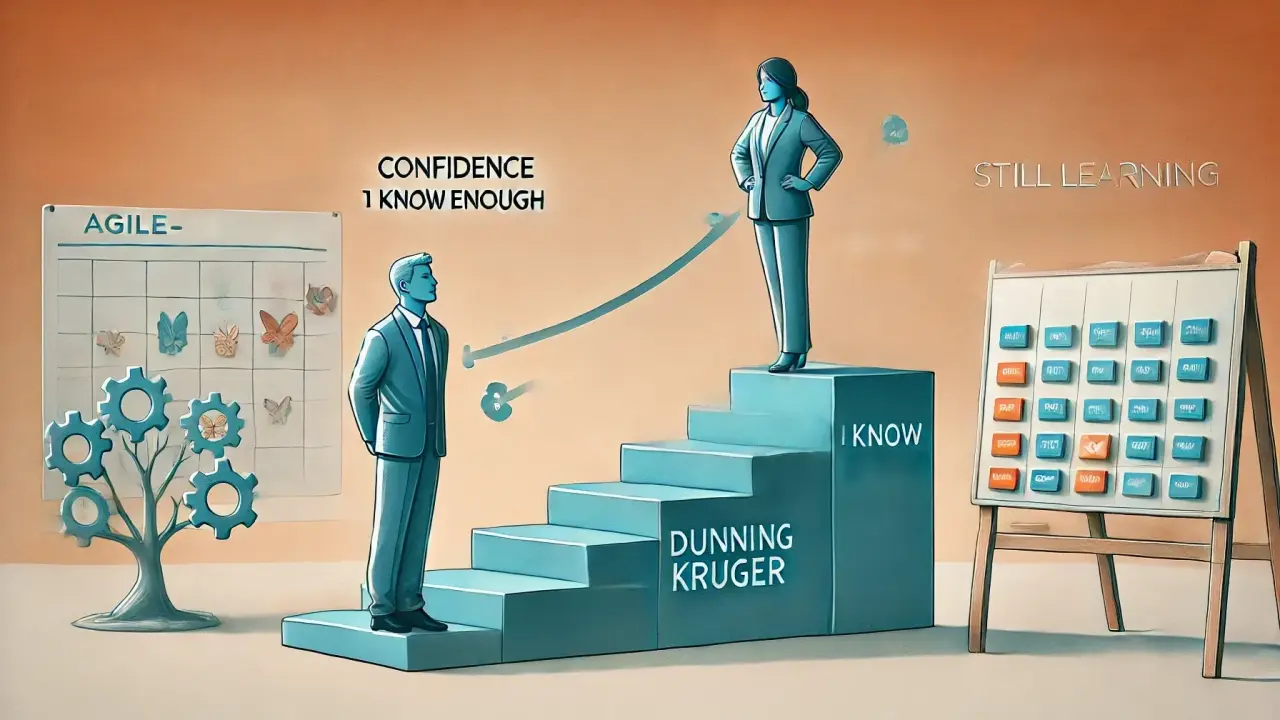
What Is the Dunning-Kruger Effect?
The Dunning-Kruger effect is a cognitive shortcut in which people with limited knowledge or skills overestimate their abilities. Paradoxically, the less they know, the more confident they feel—because they lack awareness of their own gaps.
Conversely, true experts often underestimate their abilities, assuming what is easy for them must be easy for others too.
In an Agile context, this effect can manifest in various ways:
- Newcomers to Agile methods (like Scrum or Kanban) may overestimate their understanding and promote incorrect practices.
- Experienced team members may undervalue their contributions, leading to lower engagement or hesitation in decision-making.
How It Shows Up in Scrum Teams?
The Dunning-Kruger effect can operate subtly, but with significant impact:
- 🔹 Misapplication of Agile practices: Team members who believe they “know Scrum” may skip key ceremonies (e.g. retrospectives) or distort roles (e.g. Product Owner vs. Scrum Master).
- 🔹 Overestimation of technical skills: Less experienced developers may underestimate task complexity, resulting in delays or technical debt.
- 🔹 Lack of self-reflection: Teams unaware of their limitations may skip vital steps like testing or user validation.
- 🔹 Overconfident facilitation by the Scrum Master, leading to shallow retrospectives or ineffective planning sessions.
- 🔹 Feedback is ignored: Early success convinces the team they’re on the right path—even when warning signs are clear.
Why It Hurts Team Performance?
✅ Devalues expert contributions Experienced members often remain silent when drowned out by loud but less competent opinions.
✅ Stalls team growth When people believe they “already know enough,” they stop learning—slowing both individual and team maturity.
The Dunning-Kruger effect isn’t just an individual issue—it impacts the entire team and project outcomes. In the Agile world, where success depends on collaboration and continuous improvement, being able to recognize and address this effect is essential.
Teams that embrace humility in the face of ignorance, while appreciating their strengths, achieve greater effectiveness and quality.
How to Reduce the Impact of the Dunning-Kruger Effect?
🧠 Transparent Communication Clearly define roles, expectations, and goals. Use tools like the Definition of Done to make success criteria explicit.
📊 Rely on Objective Feedback Use metrics, customer feedback, and retrospectives to reflect reality beyond personal impressions.
🗣️ Encourage Diverse Perspectives Create a psychologically safe environment where questioning ideas is welcomed—even those coming from “confident voices.”
🪞 Education and Mentoring Invest in training on Agile methods and technical skills. Experienced team members can serve as mentors for newcomers.
Final Thought?
Self-organizing teams in Agile are a powerful force—but only when confidence is paired with awareness of limitations. The Dunning-Kruger effect subtly undermines agility when assumptions replace curiosity.
Great teams don’t build success on certainty alone. They build it on curiosity, feedback, and humility. As Agile leaders, Scrum Masters, or team members, we have a responsibility to help each other grow and recognize our true competencies.
Because as the old saying goes:
“The first step toward wisdom is admitting we don’t know everything.”